Laos food: Mekong fish comes first
According to the Mekong River Commission, the average person in Laos eats 25 to 30 kilograms of fish and other aquatic animals a year. That is nearly half the animal protein eaten in the country, and across the lower Mekong, about 90% of that fish comes from the wild, not from farms[1][2]. The average hides wide gaps: the mountainous north eats less, while around the Khone Falls, in the 4,000 Islands, wild fish still supplied most of people's animal protein in the 1990s[1][4].
Nearly half of that fish is preserved: salted, dried, smoked or fermented[1]. That is how families get through the dry season, from December to May, when fresh fish becomes scarce at market[25]. Sticky rice is the base of it all: it is eaten with the fingers, rolled into small balls used to scoop up everything else[20].
Padaek, the fermented fish that seasons almost everything
Padaek is a freshwater fish paste fermented with salt. The classic ratio is three parts fish to one part salt and one part rice bran, packed into a sealed container. It is ready to eat after two or three months, better after six months to a year, and keeps without a fridge[5][6]. In a village in Vientiane province studied in 2016, more than 70% of households used it, nearly a third of them every day[5].
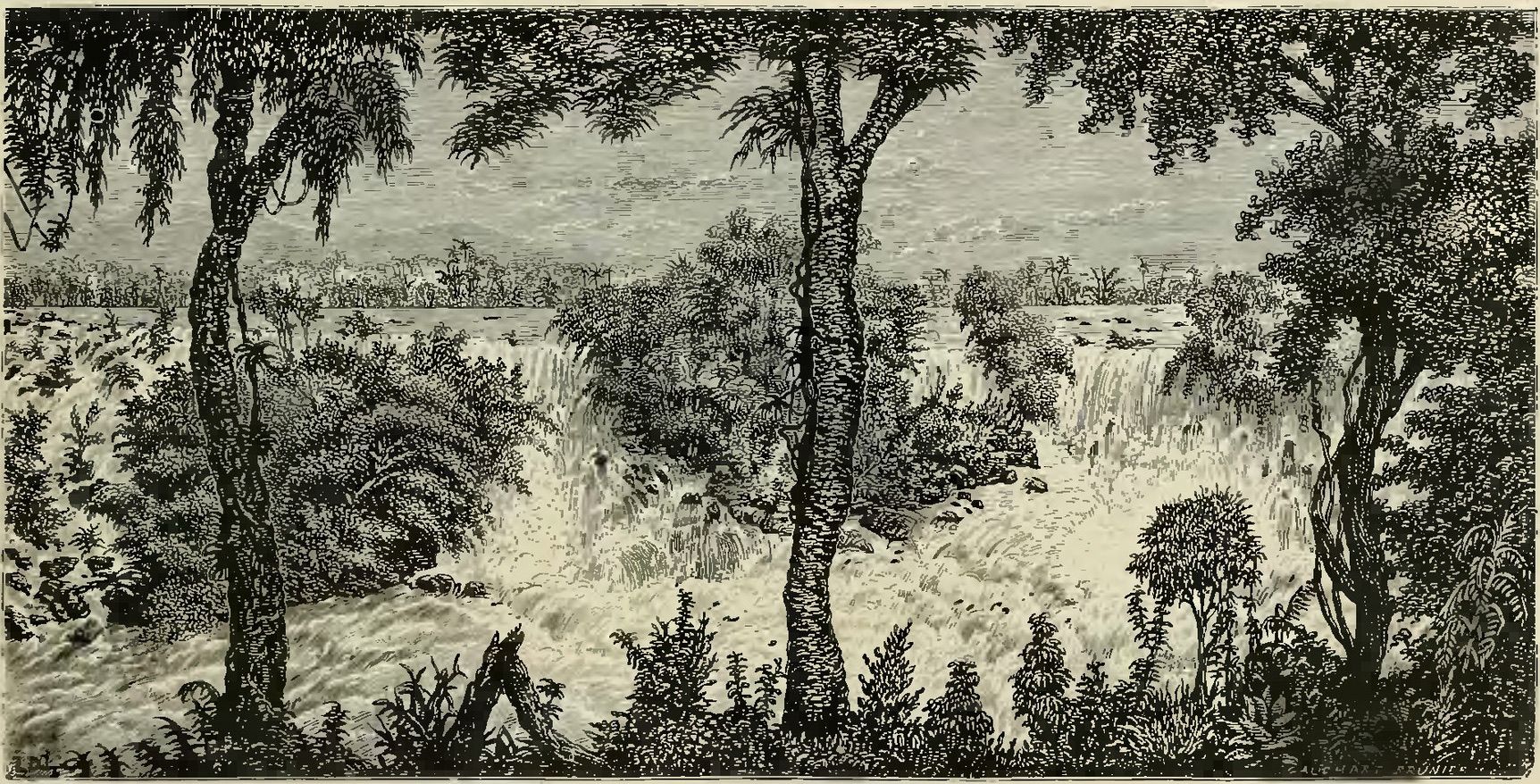
Padaek follows the river. At the Khone Falls, families make it at the end of the monsoon, with the small fish that leave the rice paddies for the Mekong, then from December to March, when shoals of pa soi, a small migratory fish from Cambodia, swim upstream. Most households went through one to three jars a year, of about 22 kilograms (50 pounds) each[4]. It goes into papaya salad, sauces, soups, laap and Luang Prabang's royal stew[5][7].
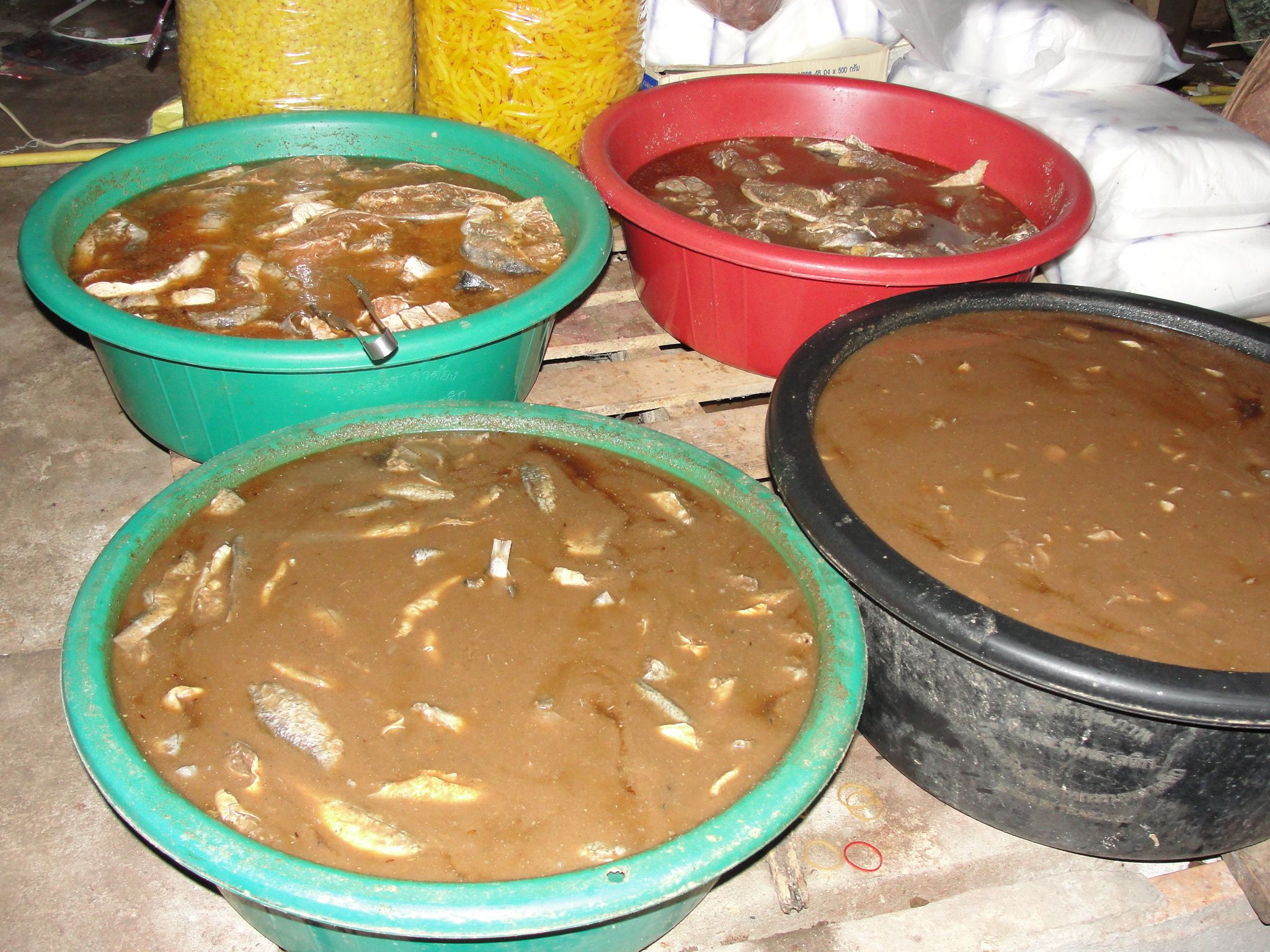
Photo by Lord Mountbatten on Wikimedia Commons · CC BY-SA 3.0
Kaipen, the Mekong river weed of Luang Prabang
In Luang Prabang, the river also gives a seaweed of sorts. Kaipen is made from a green freshwater alga of the genus Cladophora, which grows in strands on the rocks of the Mekong and the Nam Khan, where the water is clear and the current steady[8][11]. It is picked by hand in the dry season, when the river runs low[9][10].
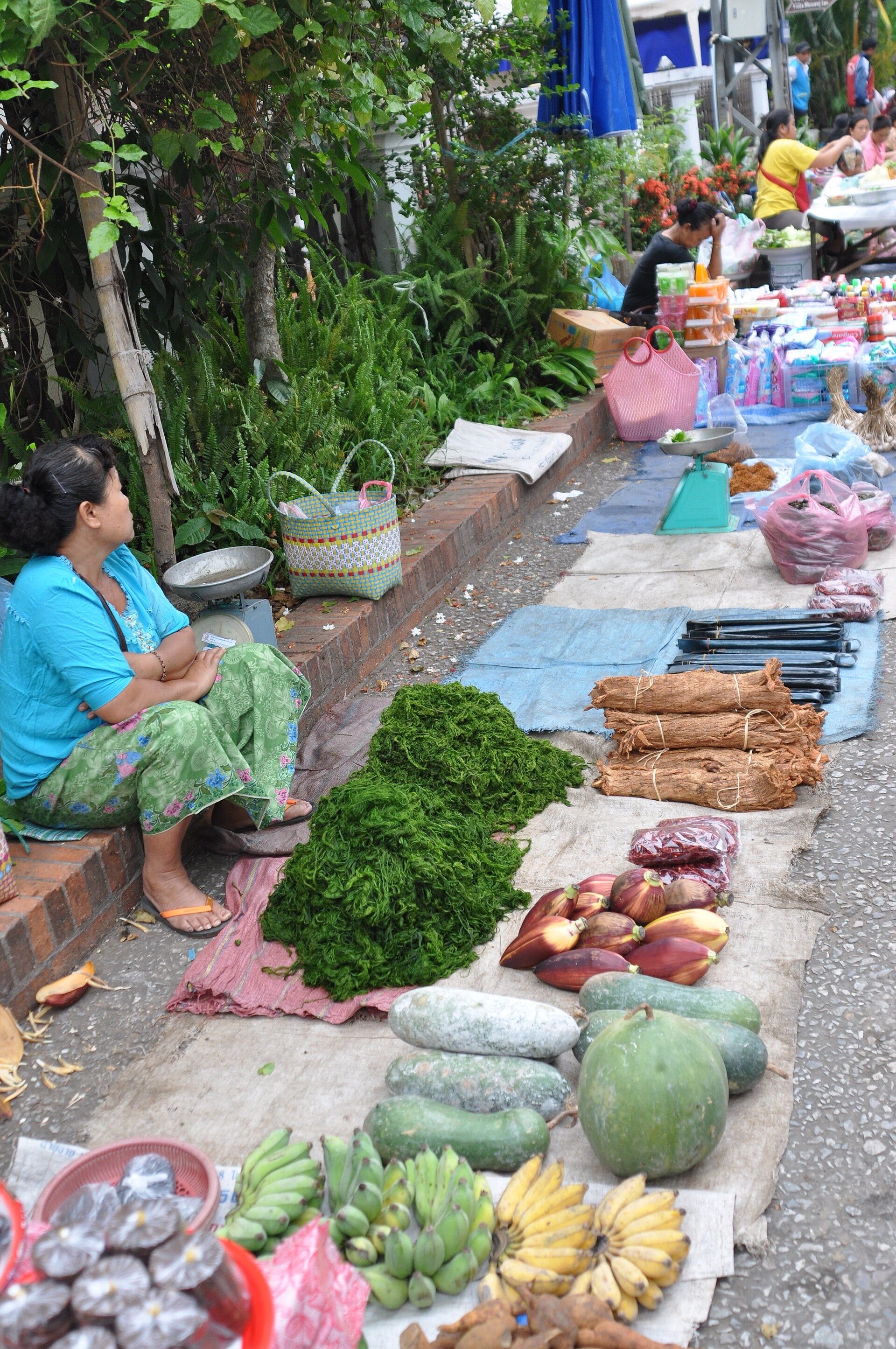
Photo by shankar s. on Wikimedia Commons · CC BY 2.0
The weed is washed, beaten to get the sand out, then spread thin on bamboo racks. It is topped with sliced tomato, garlic and sesame seeds, and dried in the sun on the riverbank[9][10]. The sheets are fried and eaten as a snack or with a meal, dipped in jeow bong, Luang Prabang's chili paste[9][10]. Fresh, the weed is also steamed in a banana leaf or added to soup[11].
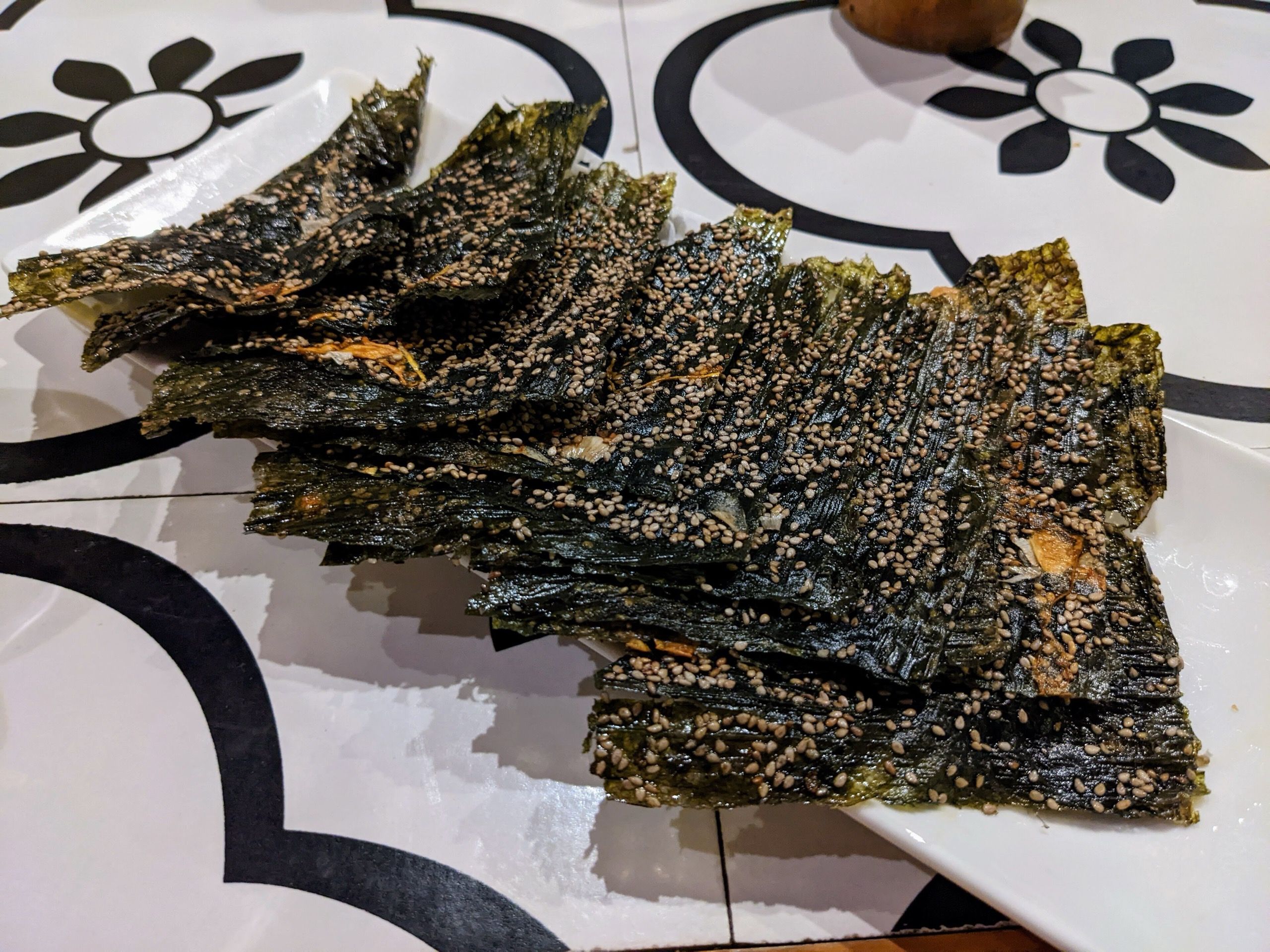
Photo by Jpatokal on Wikimedia Commons · CC BY-SA 4.0
The harvest is shrinking. A Luang Prabang producer says she now has to look for the weed in smaller rivers, and plans to source it from other northern provinces[9]. No one has yet established why.
Fish laap and mok pa, Lao-style fish
Laap is the national dish: minced meat or fish, raw or cooked, seasoned with lime, fish sauce, sometimes padaek, toasted sticky-rice powder, shallots and herbs, served with sticky rice and raw vegetables[12]. For fish laap, pa kheung, a Mekong catfish, is a common choice[15]. The royal recipe recorded by Phia Sing, chef at the Luang Prabang palace, is a raw fish laap bound with padaek[7]. Laos has nominated laap for UNESCO's intangible heritage list; as of late October 2026, no decision had been announced[12][13][14].
Raw fish has a downside: it is the main source of liver fluke infection in Laos. In one southern district, more than half of the 814 people tested were infected, and three quarters said they ate undercooked fish[16][17]. If you try fish laap, choose it cooked.
Mok pa, on the other hand, is always cooked. Fish fillets are mixed into a paste of pounded sticky rice with dill, makrut lime leaves, basil, shallots and a splash of padaek, then wrapped in a banana leaf and steamed[18].
Or lam and jeow bong, Luang Prabang's table
The old royal capital has its own specialties. Or lam is a thick stew of dried buffalo meat, grilled buffalo skin, eggplant, chilies, lemongrass, dill and padaek, flavored with sakhan, a peppery vine whose wood goes into the pot. Phia Sing warned that "there is no set recipe"[7][19]. Sakhan is sold in stems at the morning market[8].
Jeow bong, a paste of grilled dried chilies, garlic, shallots and galangal, contains thin strips of dried buffalo skin. Bong means "preserved": the paste keeps a long time[7]. It goes with kaipen, dried beef and Luang Prabang sausage[7][10].
Where to see Mekong fish: the markets of Luang Prabang, Vientiane and Pakse
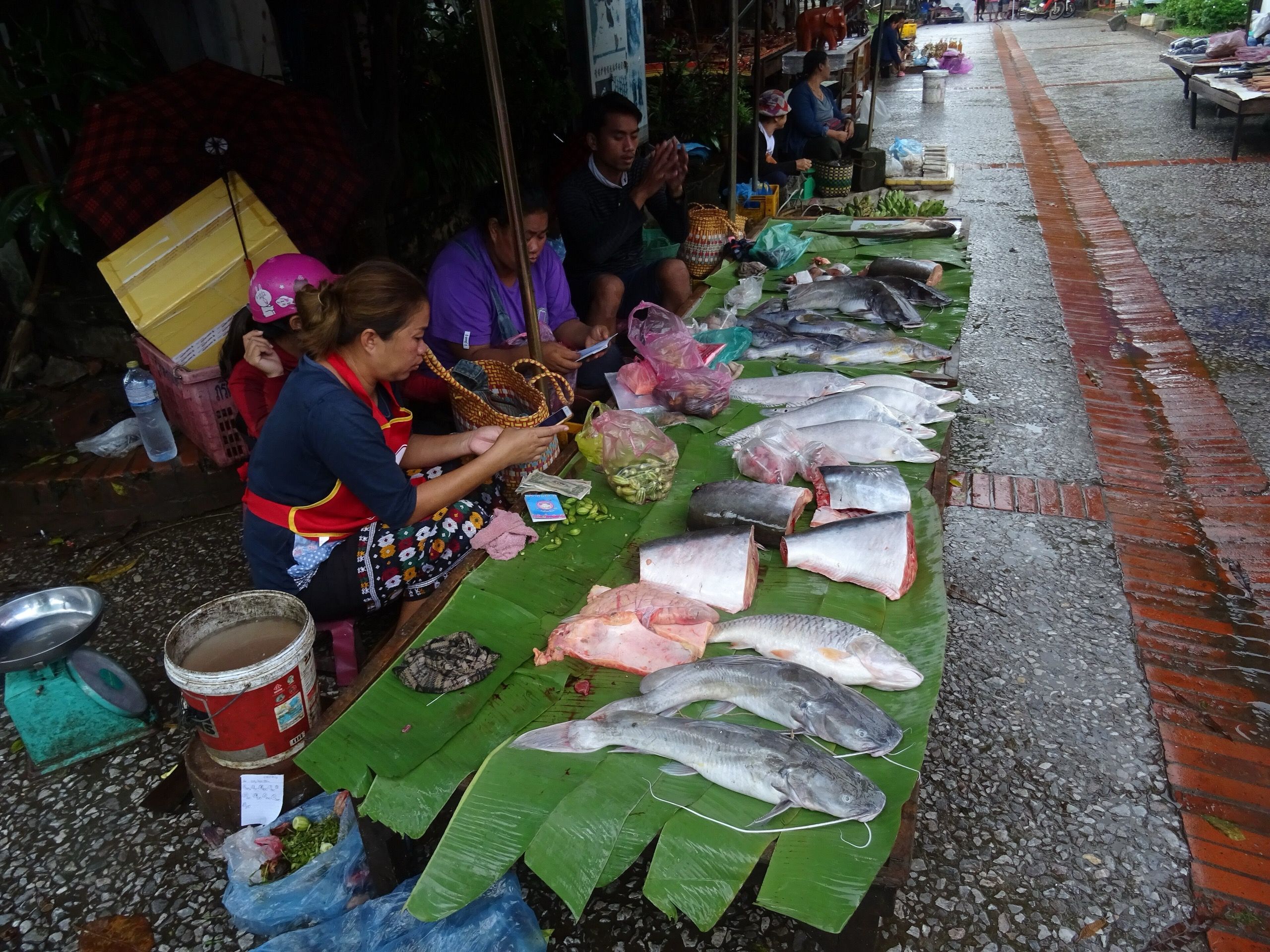
In Luang Prabang, the morning market in the old town has the widest range of wild plants: fresh and dried kaipen, sakhan and dozens of herbs. It mainly serves local residents, even though plenty of visitors walk through[8]. In 2004, Phosy market was the only one in town supplied with fish every day, caught in the Mekong and its tributaries, the Nam Ou and the Nam Khan[21].
In Vientiane, the Thongkhankham and That Luang markets were the city's two largest fish markets in 2004. Mekong fish arrived there from the Khone Falls, more than 800 kilometers (500 miles) away, and wild fish sold for about twice the price of farmed fish[21]. In Pakse, Dao Heuang market is supplied by the Nakasang landing near the falls, where middlemen buy the islands' catch from 5 a.m.[22].
Less fish in the Mekong, and so on the plate?
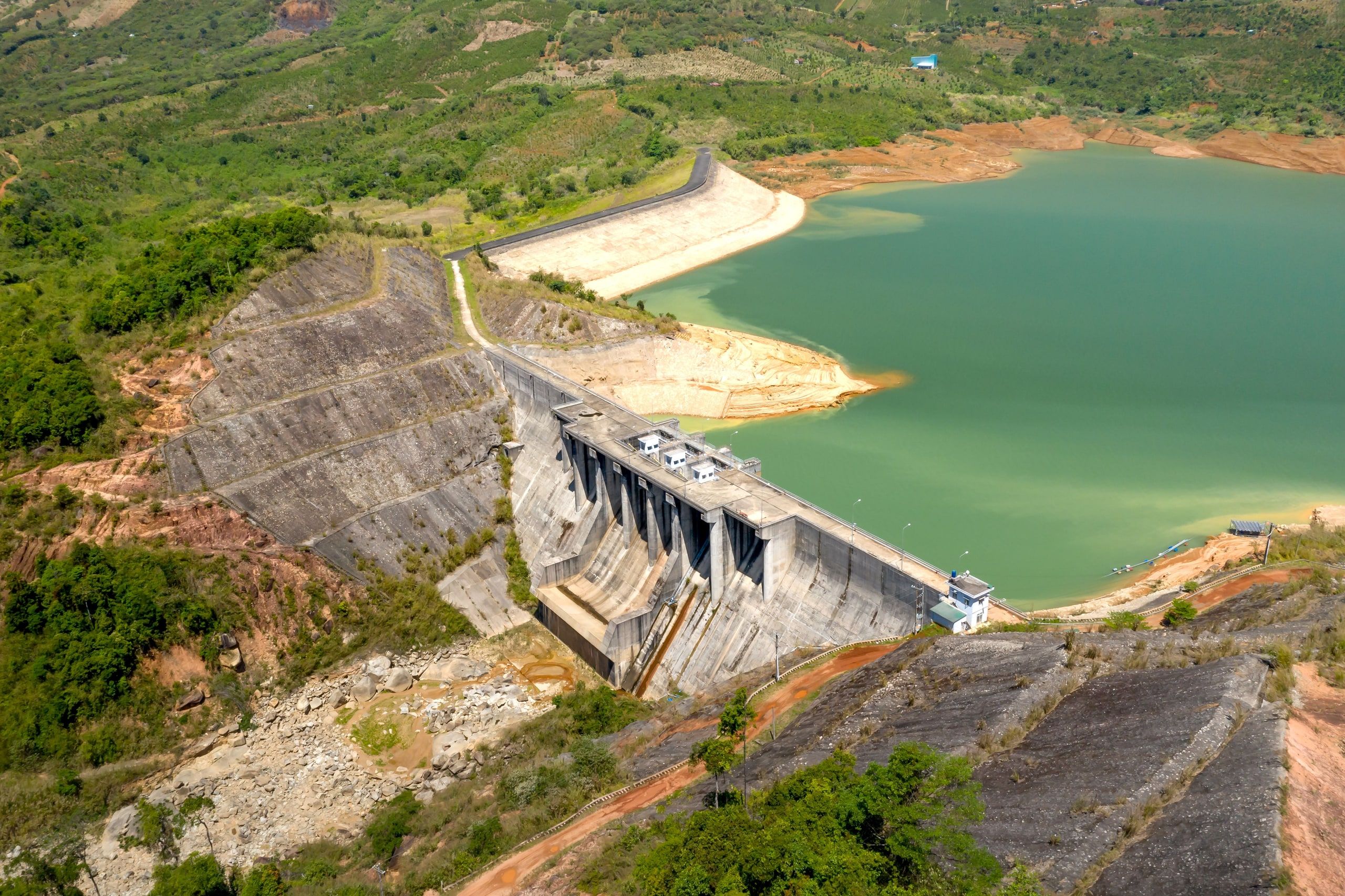
According to the Mekong River Commission, catches in the lower Mekong fell by 25 to 30% between the 2000 and 2010 assessments and the 2020 one. It lists several causes: a dry El Niño year, the drying out of floodplains, and the Mekong River dams which, along with sand mining, hold back sediment and nutrients[3]. In Laos, the number of households that fish dropped from 526,300 in 2011 to 309,800 in 2020[3].
At the Khone Falls, fishers downstream of the Don Sahong dam said in 2019 that they caught 3 to 5 kilograms a day, compared with more than 20 before; a provincial official blamed drought[24]. A 2012 study put a number on the stakes: if dams on the main river cost Laos its fish, replacing that protein with livestock would require 12 to 24% more water to grow the country's food[23].
Questions about Lao food
Is padaek the same as fish sauce?
Which Mekong fish do people eat in Laos?
What is Luang Prabang sausage?
Sources
- Mekong River Commission, Singkham Phonvisay, "An Introduction to the Fisheries of Lao PDR" , May 2013
- Mekong River Commission, Kent G. Hortle, "Consumption and the yield of fish and other aquatic animals from the Lower Mekong Basin" (summary) , October 2007
- Mekong River Commission, "Assessment of Fisheries Yield in the Lower Mekong River Basin 2020" , December 2023
- Ian G. Baird, "Khone Falls Fishers", Mekong Fisheries Network Newsletter , November 1996
- Marui, J. et al., "Assessment of usage and fermentation-related components of pa daek", JIRCAS Working Report n° 90 , March 2020
- JIRCAS and National University of Laos, "Initial salinity adjustment effectively prevents histamine accumulation in padaek" , 2020
- Phia Sing, "Traditional Recipes of Laos" (ed. Alan and Jennifer Davidson, 1981), recipes reproduced by Northern Illinois University , 2005
- Łuczaj, Ł. et al., "Wild food plants and fungi sold in the markets of Luang Prabang, Lao PDR", Journal of Ethnobiology and Ethnomedicine , January 2021
- WIPO, "Kaipen - A Traditional Laotian Snack Made Ready to Eat by NV Riverweed" , updated March 23, 2026
- Slow Food, Rob McKeown, "Kai pen, An Edible Weed" , April 29, 2002
- FISHBIO, "Green, stringy, and oh so tasty" , July 1, 2015
- Laotian Times, "Laos' National Dish Larb Eyes UNESCO Heritage Status" , February 16, 2026
- KPL (Lao News Agency), "Lao National Dish 'Larb' Steps Closer to UNESCO Recognition" , February 17, 2026
- UNESCO, Intangible Cultural Heritage, page "Lao People's Democratic Republic" , accessed October 28, 2026
- Laotian Times, "International Fisheries Experts Introduced to Lao Fish Larb" , February 8, 2021
- Sayasone, S. et al., "Epidemiology of Opisthorchis viverrini in a rural district of southern Lao PDR", Transactions of the Royal Society of Tropical Medicine and Hygiene , 2007
- Eom, K. S. et al., "Prevalence of helminthic infections among inhabitants of Lao PDR", Korean Journal of Parasitology , 2014
- FISHBIO, "Mekong fish and banana leaves" , August 2, 2013
- Laotian Times (from Champa Meuanglao), "Or-Laam: A Dish Fit For A King" , May 3, 2017
- Smithsonian Magazine, Mike Ives, "A Taste of Sticky Rice, Laos' National Dish" , February 1, 2011
- Phonvisay, A. et al., "Monitoring of fish markets in Vientiane and Luang Prabang Province, Lao PDR, using logbooks", 7th Technical Symposium on Mekong Fisheries , November 2005
- FISHBIO, "Fish Landing in Laos" , October 11, 2017
- Orr, S. et al., "Dams on the Mekong River: Lost fish protein and the implications for land and water resources", Global Environmental Change , October 2012
- Radio Free Asia, "Village Fishermen Near Laos' Don Sahong Dam Report Smaller Catches" , October 24, 2019
- FISHBIO, "One fish" , April 4, 2012
- Laotian Times, "Luang Prabang's Sai Oua Ranked Among World's Top 20 Cooked Sausages of 2025" , July 31, 2025

Pierre-Marie Coupry
Editor-in-chief of the French travel site Bon Plan Voyage, where he has published since 2012. He checks every practical detail against official sources and proofreads everything before it goes live.
Our method