82 centimeters above the sea, on average
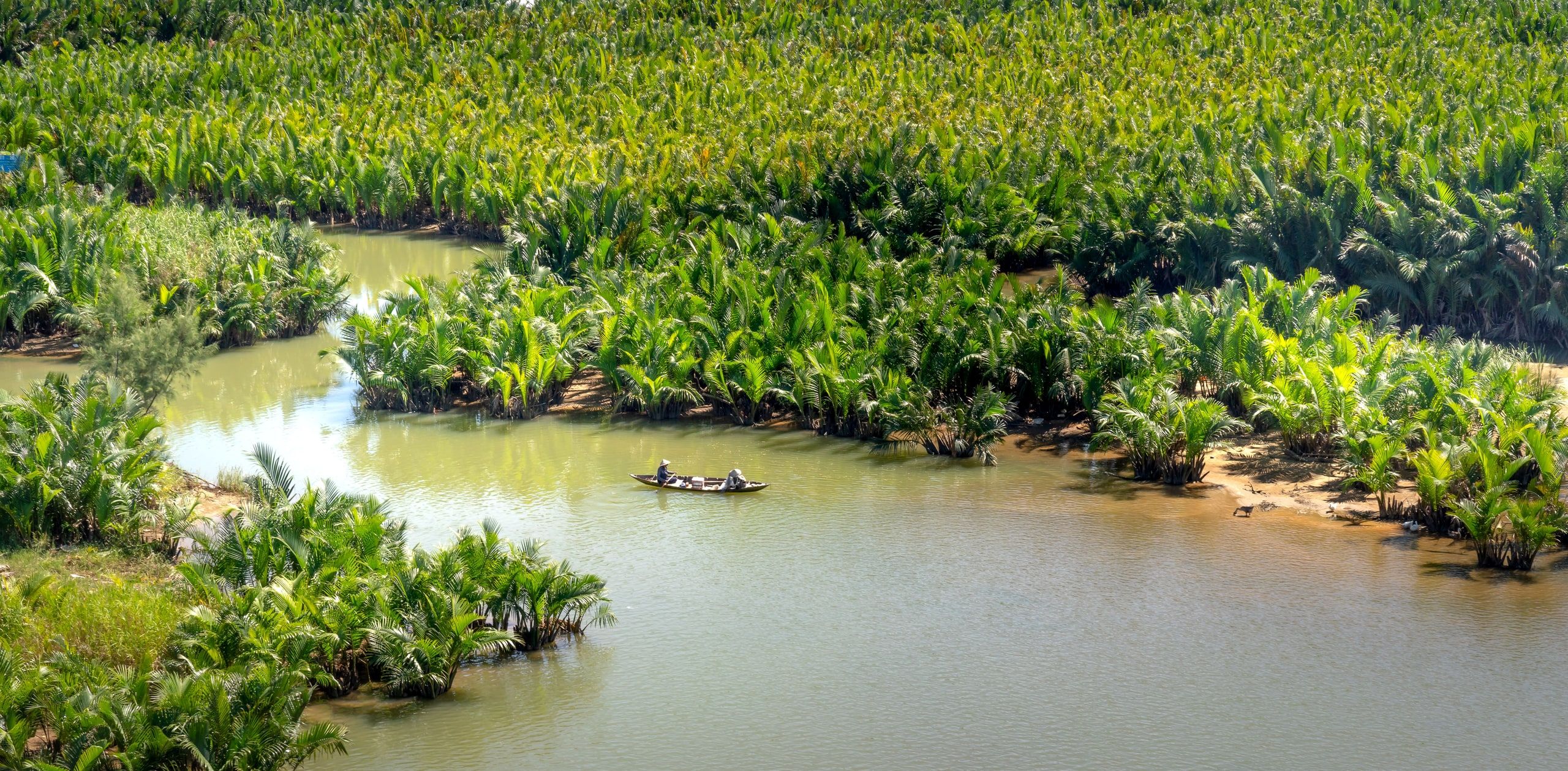
For a long time, satellite models put the Mekong Delta more than two meters above the sea. In 2019, researchers at Utrecht University redid the math using Vietnamese topographic maps: the plain's average elevation is just 82 centimeters (2.7 feet). It is 95 centimeters in Bến Tre province, 72 in Cần Thơ, and under 40 in the western delta, around Kiên Giang and Hậu Giang[1][2].
That is a thin margin for a region of nearly 18 million people that grows most of Vietnam's rice. With 50 centimeters of relative sea-level rise, 29% of the plain would fall below sea level; with one meter, three quarters, home to 12.3 million people[1].
Water pumped from under the rice fields
The delta's ground is dropping by roughly a centimeter a year on average, and by several centimeters in places, especially in cities[3][4]. A satellite radar study published in Nature in January 2026 found 17% of the area sinking by more than a centimeter a year. Everywhere, that is far faster than the sea is rising offshore, by about 3.4 millimeters a year[5].
The main human cause is groundwater pumping. Around 2015, the delta drew more than 2.5 million cubic meters a day from more than 15,000 extraction points, 80% of it in the countryside[3]. As the water table drops, clay and peat compact. Between 1991 and 2015, pumping cost the delta 18 centimeters on average, more than 30 in the worst-hit areas[3]. Natural compaction of young sediment and the weight of buildings add to it[3][1].
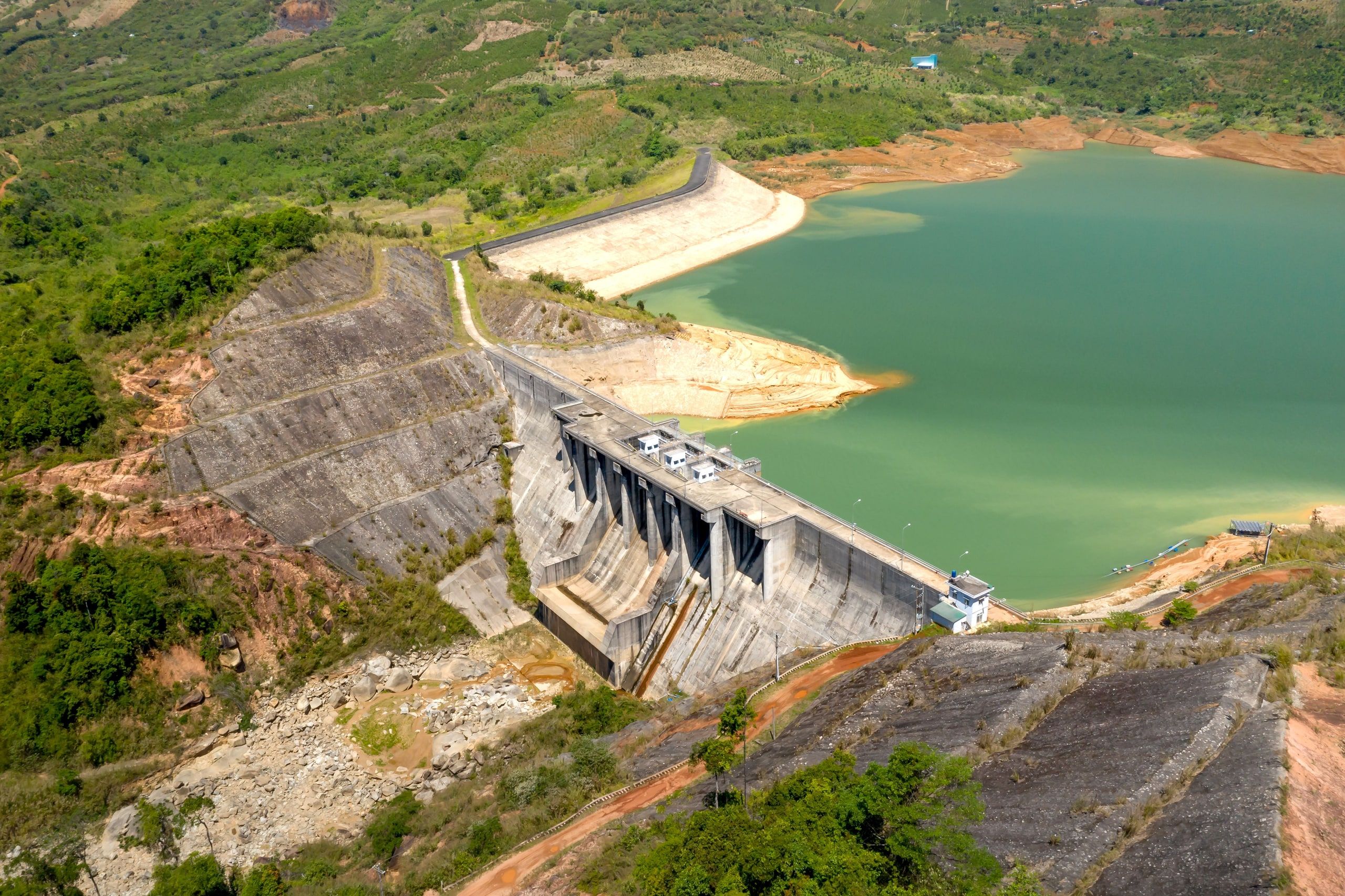
Floods used to make up for it by laying down silt: the delta rose by 0.3 to 1.8 millimeters a year[11]. Not anymore. More than half of the sediment it used to receive is now trapped by the Mekong River dams, and rice-field dikes keep floods from spreading what is left[8]. According to a 2022 study, the delta is now losing elevation instead of gaining it[6].
Sand dredged from the Mekong and the Bassac
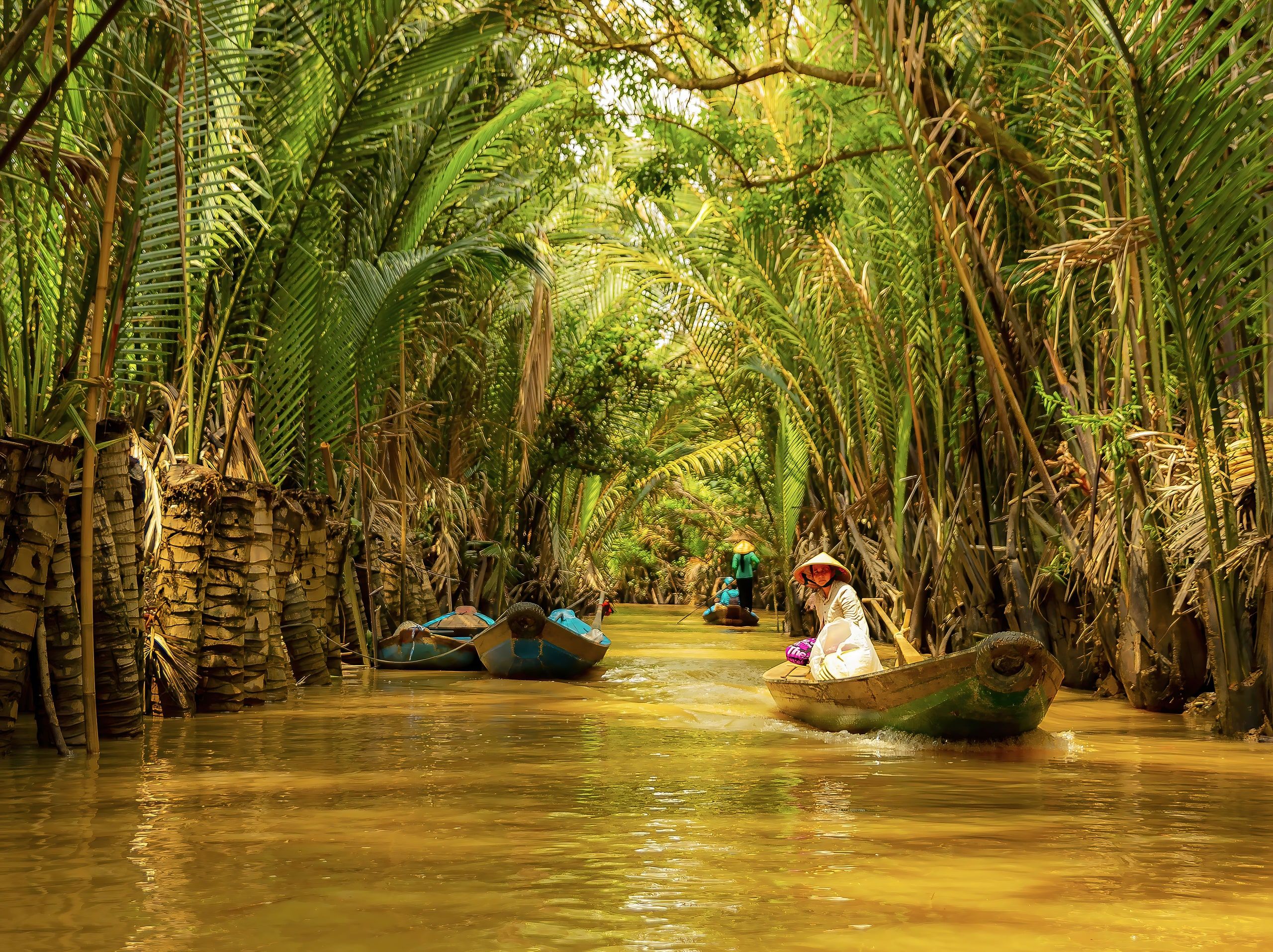
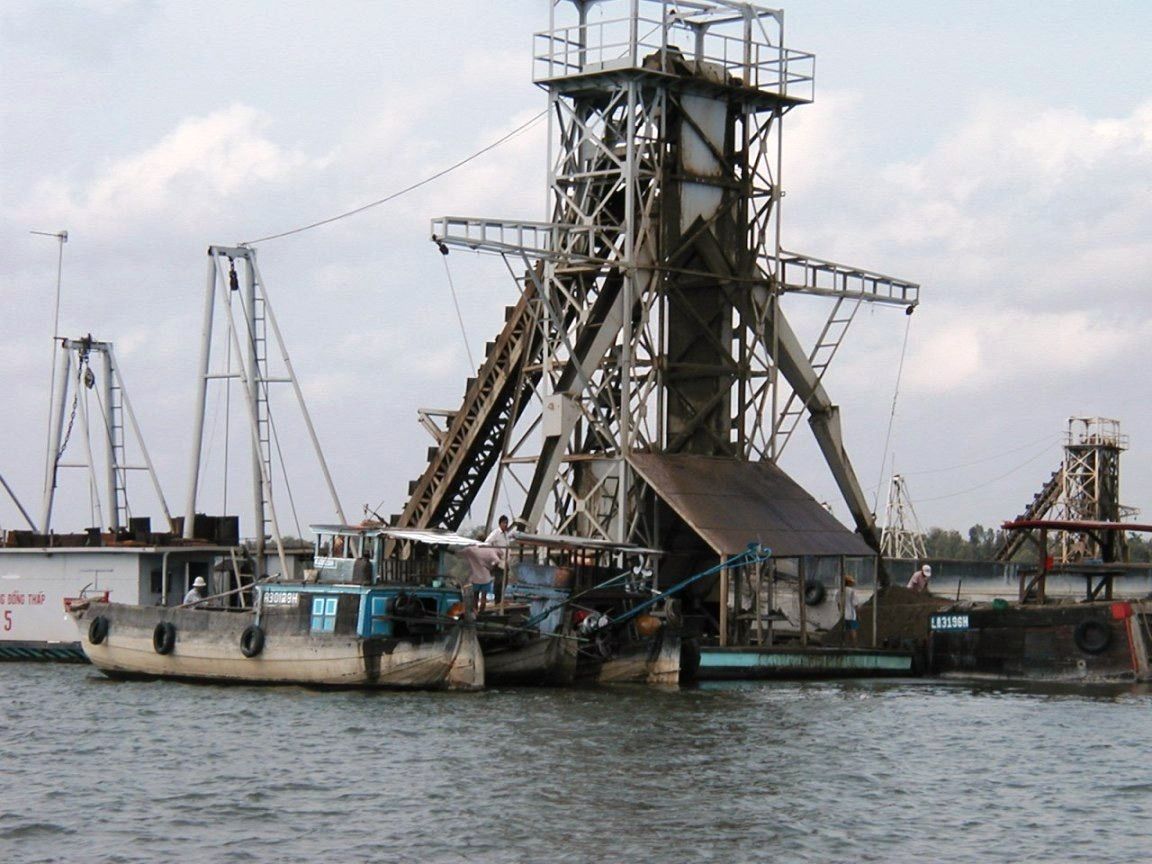
The second cause is sand. About 50 million tonnes a year are dredged from the Mekong's bed in Cambodia and Vietnam, while the river brings only about 6 million to the delta[9]. For the Vietnamese delta alone, WWF estimated extraction in 2023 at 35 to 55 million cubic meters a year, some fifteen times the natural supply. At that rate, the minable stock would run out before 2035[12][13]. Official figures are considered far too low: on just 20 kilometers of the Tiền River, sonar surveys found more than a quarter of the volume declared for the whole delta[11].
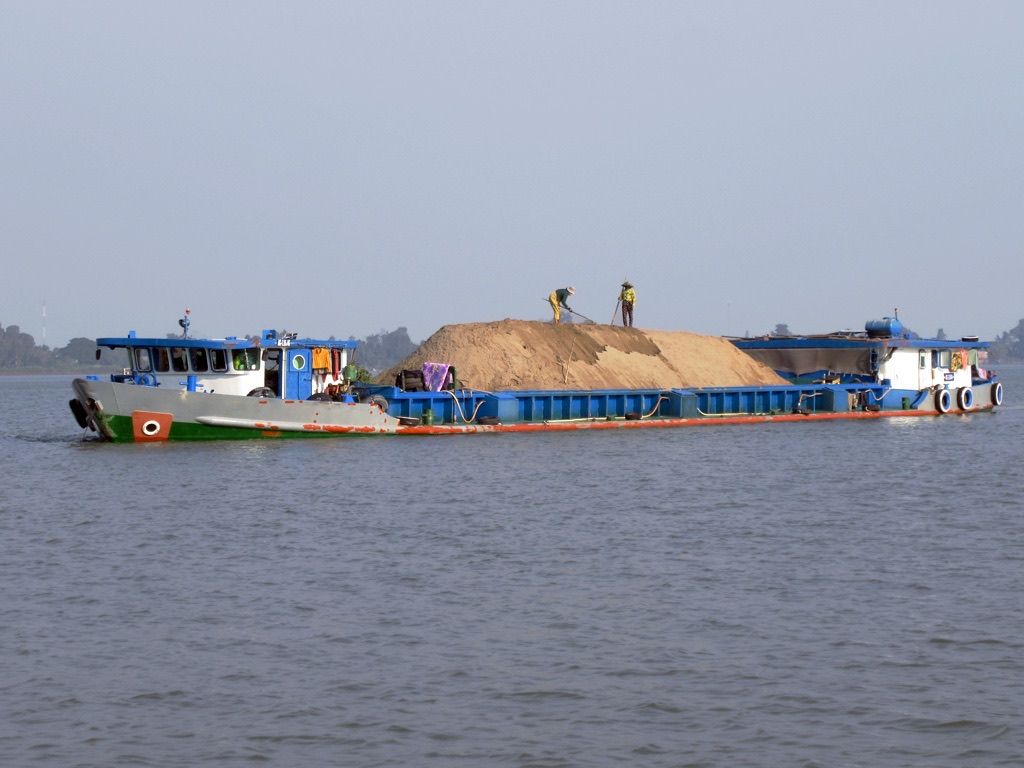
Photo by David Stanley on Wikimedia Commons · CC BY 4.0
A deeper riverbed weakens the banks: according to the University of Southampton, lowering it by about two meters is enough to make many banks collapse[10]. Vietnam's Agriculture Ministry counts nearly 800 erosion sites along 1,134 kilometers of riverbanks and coastline[13]. Along the coast, more than half of the delta's 600 kilometers was retreating between 2003 and 2012[14]. And a deeper riverbed lets seawater push farther inland[14][8].
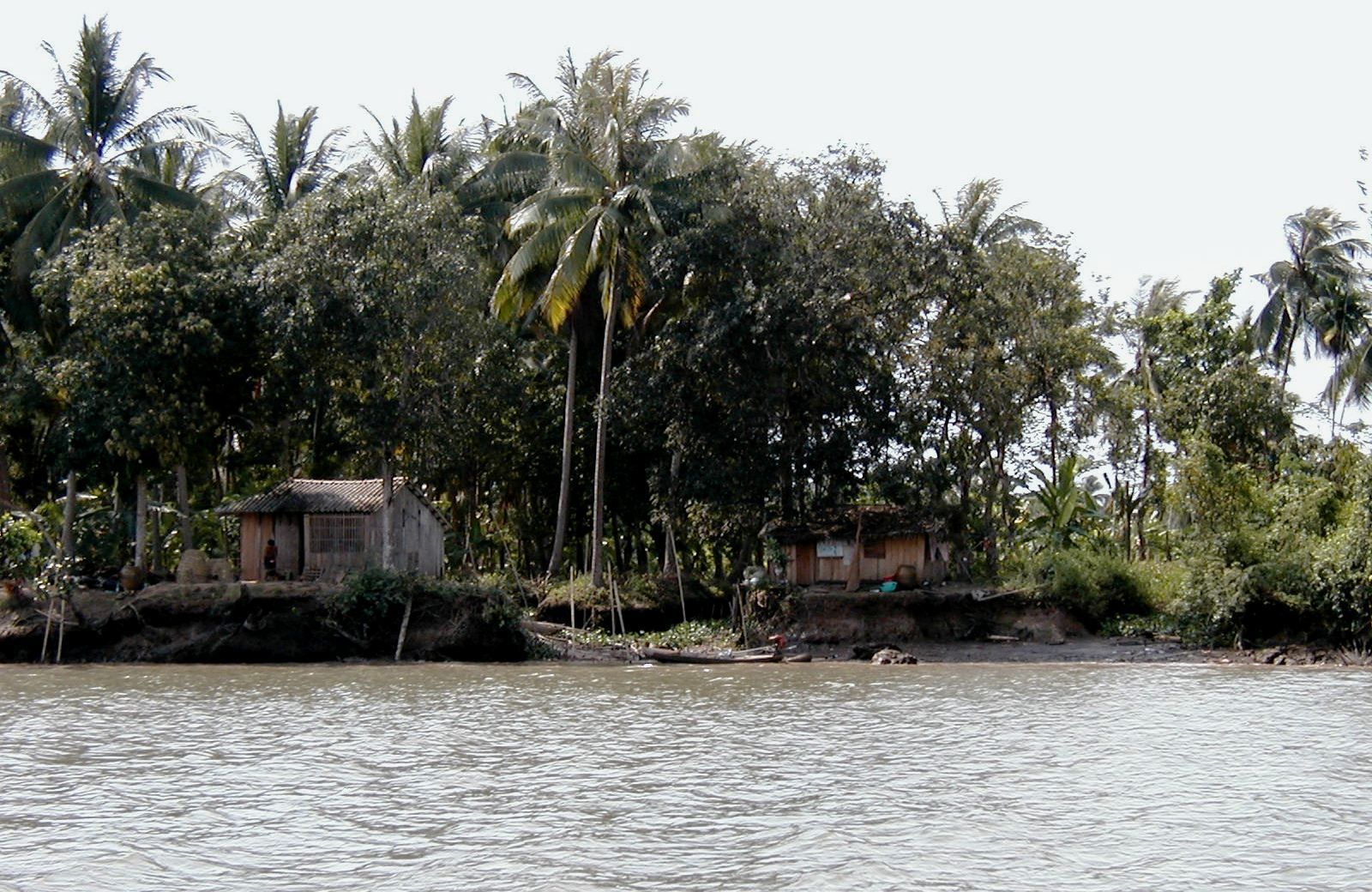
Photo by BacLuong on Wikimedia Commons
Saltwater intrusion is reaching farther into the delta
In the dry season, when the river runs low, the sea pushes up its branches. In 2016, the worst drought in about a century hit 221,000 hectares of rice and cut off fresh water to 225,000 coastal households, for $215 million in losses[15]. In 2020, water carrying 4 grams of salt per liter, the threshold above which rice suffers, reached 50 to 95 kilometers inland depending on the branch, 2 to 11 kilometers farther than in 2016 and a month earlier[16]. At least five provinces declared a state of emergency, Bến Tre first[17].
In Bến Tre, in March 2020, tap water exceeded the drinking-water limit, and the water company apologized to 80,000 customers[18]. In Chợ Lách, 1,600 hectares of orchards were damaged, and the village fruit festival was canceled in both 2016 and 2020[19][20]. In Cần Thơ, nearly 100 kilometers from the sea, the Hậu River reached 3.5 grams per liter at Cái Cui port in February 2020, without affecting the city's tap water[16]. The 2024 season was less severe, although in early April water at 4 grams per liter still reached 62.4 kilometers up the Hàm Luông branch in Bến Tre[21][31].
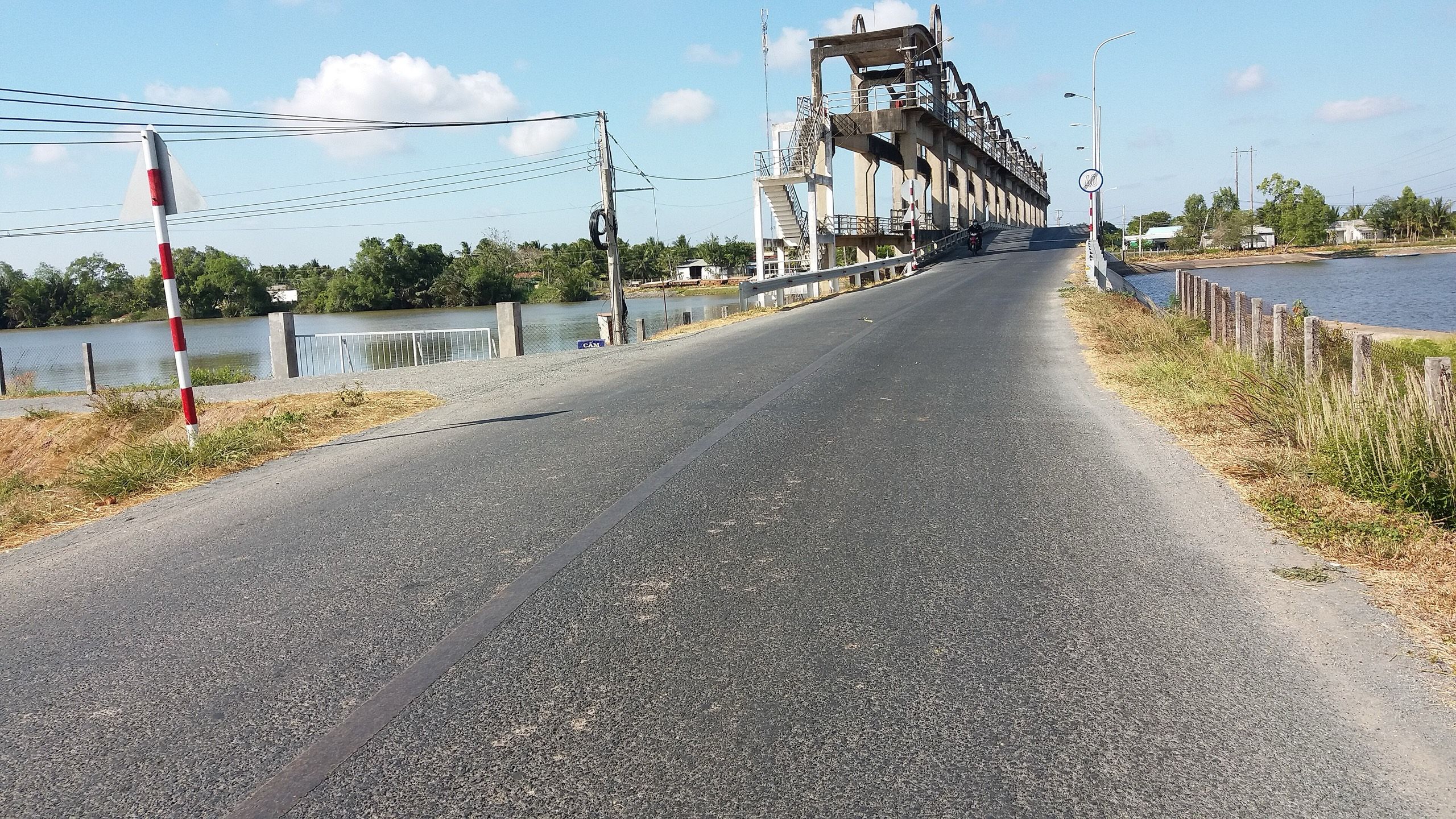
Photo by TUIBAJAVE on Wikimedia Commons · CC BY-SA 4.0
The salt season is also starting earlier: before 2012 it ran from February to April; it now begins in late December and peaks in February and March[22]. For the coming winter, the Southern Institute of Water Resources Research expects saltwater 50 to 65 kilometers from the river mouths in January and February 2027, on a par with 2016, then even farther in early March, for lack of rain across the basin[23]. To plan a trip in that season, see when to visit the Mekong Delta.
The Mekong Delta in 2050 and 2100, according to researchers
According to a 2022 study, the delta's average elevation could drop by half a meter relative to the sea by 2050[6]. By 2100, pumping alone would take away 68 centimeters to a meter if nothing changes, versus 12 to 39 centimeters if extraction is stabilized or reduced. With moderate sea-level rise, only 32% of the delta would then remain above sea level in the first case, 57% if pumping is cut by three quarters[7]. Counting sand and dams too, 21 researchers estimated in 2022 that relative sinking could reach 1.8 meters by 2100, with more than 90% of the delta below sea level[8].
What Vietnam is doing to save the delta
In 2017, a government resolution changed the doctrine: the goal is no longer just to live with floods, but also with brackish and salt water. It calls for strict control of sand mining and for shifting rice land to less water-hungry crops[24]. A 2018 decree restricts pumping in sinking areas, but enforcement remains weak given the sheer number of wells[7][25][26].
On the ground, the country is building saltwater defenses such as the Cái Lớn - Cái Bé sluice system, opened in 2022 at a cost of $144 million and covering 384,000 hectares[27]. It also promotes rice-shrimp rotation, rice in the rainy season and shrimp in the dry season: nearly 190,000 hectares in 2022[28]. Researchers say the time available is shorter than the government's plans assume[7][8].
Questions about the sinking Mekong Delta
Why did satellite maps overestimate the delta's elevation?
Is Ho Chi Minh City sinking too?
What is the Funan Techo canal?
Sources
- Minderhoud, P. S. J. et al., "Mekong delta much lower than previously assumed in sea-level rise impact assessments", Nature Communications , August 2019
- Utrecht University, "Elevation of sinking Mekong Delta wrongly estimated for decades" , August 28, 2019
- Minderhoud, P. S. J. et al., "Impacts of 25 years of groundwater extraction on subsidence in the Mekong delta, Vietnam", Environmental Research Letters , June 1, 2017
- Erban, L. E., Gorelick, S. M., Zebker, H. A., "Groundwater extraction, land subsidence, and sea-level rise in the Mekong Delta, Vietnam", Environmental Research Letters , August 15, 2014
- Ohenhen, L. O., Shirzaei, M. et al., "Global subsidence of river deltas", Nature , January 14, 2026
- Dunn, F. E., Minderhoud, P. S. J., "Sedimentation strategies provide effective but limited mitigation of relative sea-level rise in the Mekong delta", Communications Earth & Environment , January 2022
- Minderhoud, P. S. J. et al., "Groundwater extraction may drown mega-delta", Environmental Research Communications , January 2020
- Kondolf, G. M. et al., "Save the Mekong Delta from drowning", Science , May 5, 2022
- Hackney, C. R. et al., "River bank instability from unsustainable sand mining in the lower Mekong River", Nature Sustainability , January 13, 2020
- ScienceDaily, from the University of Southampton, release on Hackney et al. , January 14, 2020
- Jordan, C. et al., "Sand mining in the Mekong Delta revisited", Scientific Reports , November 2019
- VietNamNet, "Mekong Delta's sand resources likely to be depleted by 2035" (WWF report) , October 1, 2023
- AFP via GMA News, "Vietnam's Mekong Delta may run out of sand by 2035 - study" , October 6, 2023
- Anthony, E. J. et al., "Linking rapid erosion of the Mekong River delta to human activities", Scientific Reports , October 8, 2015
- Viet Nam News, "Mekong drought losses total $215m" , June 25, 2016
- VnExpress, "Nước mặn tràn vào Cần Thơ" (in Vietnamese) , February 12, 2020
- Tuổi Trẻ News, "Vietnam's Mekong provinces declare state of emergency amid record drought, saltwater intrusion" , March 5, 2020
- VnExpress, "Nước máy ở Bến Tre nhiễm mặn" (in Vietnamese) , March 19, 2020
- Tuổi Trẻ (Pháp Luật TP.HCM), "Mất mùa vì hạn mặn, Bến Tre không tổ chức lễ hội cây trái ngon" (in Vietnamese) , May 4, 2020
- SGGP, "Hàng ngàn ha vườn cây đặc sản ở ĐBSCL bị thiệt hại do hạn mặn" (in Vietnamese) , May 6, 2020
- Vietnam National Center for Hydro-Meteorological Forecasting, saltwater intrusion bulletin of April 10, 2024 (in Vietnamese) , April 10, 2024
- Nhân Dân, "Hạn mặn miền Tây, cả nước chung tay vì Việt Nam là nhà" (in Vietnamese) , June 22, 2024
- Tiền Phong, "Khuyến cáo miền Tây ứng phó hạn, mặn gay gắt mùa khô sắp tới" (in Vietnamese) , October 5, 2026
- Government of Vietnam, Resolution 120/NQ-CP on sustainable development of the Mekong Delta (LuatVietnam translation) , November 17, 2017
- Viet Nam News, "Low-lying Mekong Delta deals with worsening land subsidence" , November 27, 2021
- Utrecht University, "Mekong delta" page (Sinking deltas case study) , accessed October 28, 2026
- Tuổi Trẻ News, "$144mn irrigation project inaugurated in Vietnam's Mekong Delta" , March 6, 2022
- Viet Nam News, "Mekong Delta to expand shrimp-rice farming" , April 3, 2023
- Viet Nam News, "Cambodian Funan Techo Canal might reduce water flow to Hậu River: experts" , April 24, 2024
- Le Petit Journal Cambodge, "Le Cambodge engage la deuxième phase du canal Funan Techo" (in French) , April 19, 2026
- Tuổi Trẻ, "Giảm 10% giá nước sinh hoạt cho người dân Bến Tre" (in Vietnamese) , April 9, 2024

Pierre-Marie Coupry
Editor-in-chief of the French travel site Bon Plan Voyage, where he has published since 2012. He checks every practical detail against official sources and proofreads everything before it goes live.
Our method